
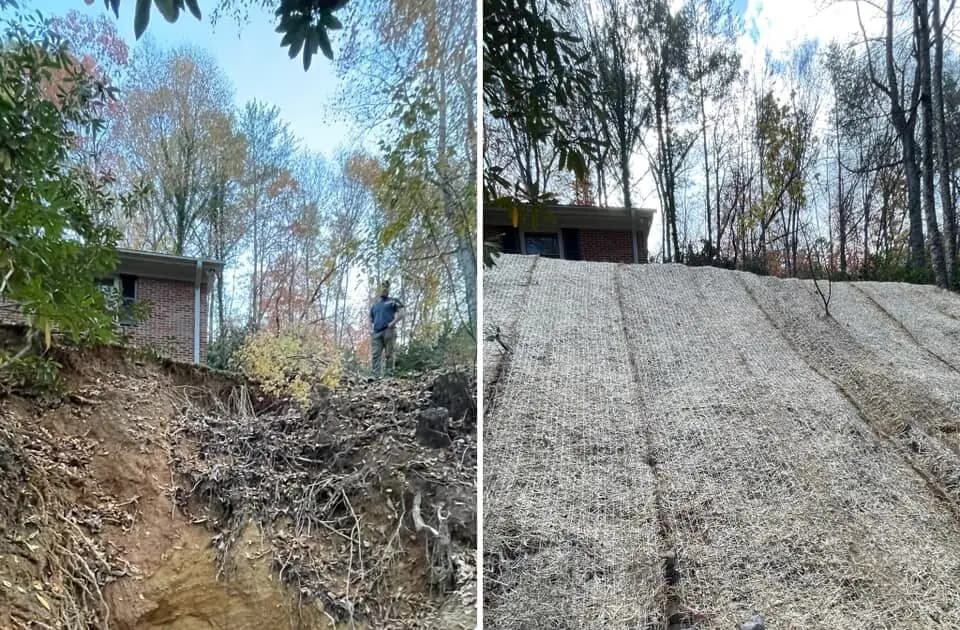
Western North Carolina gets a lot of rain, much of it fast and heavy, onto a lot of slope. That combination moves soil, and once it starts moving it accelerates — a small channel concentrates flow, concentrated flow cuts faster, and the channel gets bigger. Catching it early is the whole game.
What to look for after a hard rain
Channels and gullies cutting across the ground
Small rills that appear in bare soil after a storm are the first stage. Left alone they deepen into gullies. Once a channel is deep enough that you would notice it on a mower, it is carrying enough water to keep growing on its own.
Exposed roots and undercut trees
Roots that were covered a few years ago and are visible now mean the soil around them has left. Trees leaning downhill with soil pulled away from the uphill side are a slope stability warning, not just an erosion one.
Silt and sand deposited where water slows down
Fans of sediment at the bottom of a slope, in the driveway, across a road or in a ditch are the physical evidence of what you lost upslope. If you are cleaning silt out of the same spot every year, something above it is eroding every year.
A bank that keeps slumping or sliding
Cut banks that were stable when they were new and have started to slough are usually over-steep for the soil, saturated from behind, or both. This one is worth addressing quickly — a slow slump can become a failure.
Muddy runoff leaving your property
Clear water leaving a site means the soil is staying. Brown water means it is not. Beyond the property loss, sediment leaving a site during land-disturbing work is a regulatory problem in North Carolina.
Water where it never used to be
New wet spots, a spring that appeared after nearby work, or water crossing the driveway in a new place all mean flow has been redirected. Something upslope changed — a culvert plugged, a ditch filled in, or grading somewhere sent water a new direction.
The fixes, cheapest first
| Solution | Best for | Typical cost |
|---|---|---|
| Seeding & straw / matting | Gentle slopes, bare ground | $0.50 – $2 per sq ft |
| Ditch cutting or reopening | Directing surface flow | $500 – $2,000 |
| Swale grading | Moving sheet flow across a site | $800 – $3,000 |
| Culvert installation | Crossing a drive or road | $1,500 – $4,000 |
| Riprap armoring | Outlets, concentrated flow, creek banks | $3,000 – $10,000+ |
| Bank resloping & stabilization | Failing or over-steep cuts | $3,000 – $15,000+ |
| Retaining wall | Holding a slope you need to use | $35 – $65 per sq ft of face |
Why grass alone is not always the answer
Established vegetation is the cheapest and best long-term erosion control on a gentle slope with reasonable runoff, and it should be the default anywhere it will work. Where it will not work is anywhere flow is concentrated: culvert outlets, the bottom of a swale, creek edges, steep cuts and anywhere water arrives with velocity. In those spots water gets under the root mat and takes the whole thing, grass and all. Those places need stone, matting or a structural solution.
Erosion control during construction
North Carolina requires an approved erosion and sedimentation control plan for land-disturbing activity of one acre or more, and some local jurisdictions set a lower threshold. Standard measures on an active site include silt fence, construction entrances, sediment traps or basins, diversion ditches and temporary seeding on anything left bare.
The practical reason to take this seriously, beyond compliance: bare graded ground on a slope in this region can lose an astonishing amount of material in one storm. The cost of putting the soil back and repairing the damage always exceeds the cost of the measures that would have held it.