
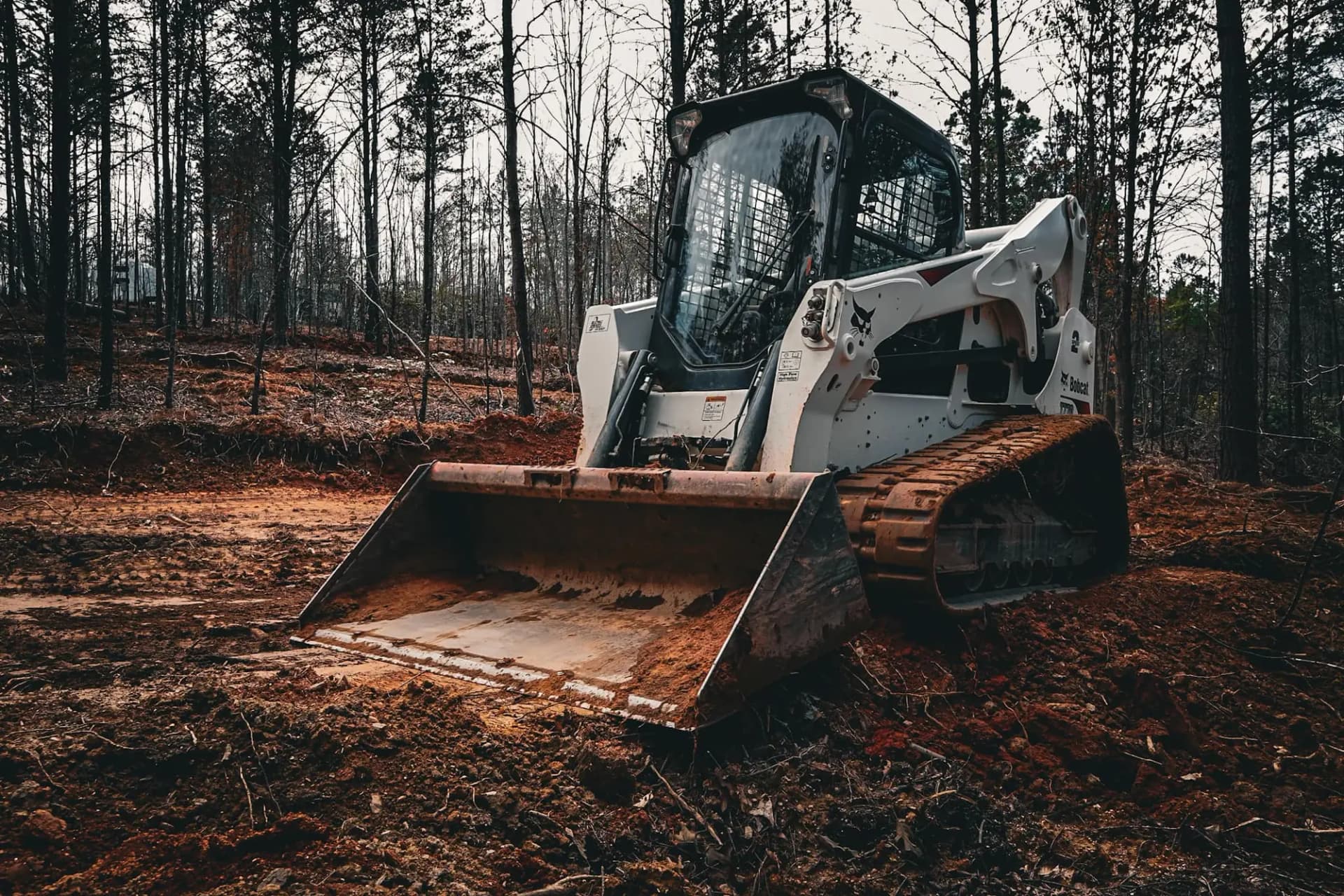
In Western North Carolina, expect roughly $1,500 to $3,500 per acre for light brush and scattered trees, and $3,500 to $8,000 per acre for dense woods where the stumps have to come out. Steep, hard-to-access mountain parcels run above that, and there is real range within each of those bands depending on your specific lot.
The longer answer is that per-acre pricing is a rough guide at best, because almost nobody clears a whole acre uniformly. Most homesites need a building pad, a driveway corridor and a yard — often well under an acre in total — which is why the real number usually comes in below what the per-acre figure suggests.
Land clearing cost by density
| Site condition | Typical range per acre | What that includes |
|---|---|---|
| Light brush & grass | $800 – $2,000 | Mowing, brush cutting, minimal debris |
| Brush with scattered trees | $1,500 – $3,500 | Brush removal, small tree removal, debris piled |
| Moderately wooded | $2,500 – $5,500 | Tree removal, some stump work, debris handled |
| Densely wooded, mature hardwood | $3,500 – $8,000 | Full tree removal, stump grubbing, hauling |
| Steep or limited-access mountain lot | $5,000 – $12,000+ | All of the above plus access work and erosion control |
What actually drives the price
In this region, two factors move a clearing estimate more than anything else, and neither of them is how many trees are standing.
1. Slope
Working on grade is slower, requires more care and usually requires erosion control measures that flat ground does not. A one-acre parcel at 5% grade and the same acre at 30% are genuinely different jobs. On steep ground you are also managing where the debris and the soil go, because gravity is going to have an opinion.
2. Access
If equipment can reach the work area easily, clearing moves fast. If the only way in is a narrow existing drive with a tight turn, or there is no route at all until one is cut, that becomes phase one of the project. Access is the most common reason two similar-looking lots price very differently.
3. What happens to the debris
Debris disposal is frequently a quarter to a third of a clearing bill. The options, cheapest first:
- Windrowing: pushing material into a pile or row along a property edge. Cheapest, and it doubles as a screen and wildlife habitat.
- Burning: only where county rules and conditions permit, and it needs someone on site.
- Chipping: turns debris into mulch you can use, costs more in machine time.
- Hauling off: cleanest result, most expensive, priced by the load.
If your parcel has merchantable timber on it, talk to a logger before you talk to a clearing contractor. On a well-timbered tract, the value of the wood can offset a real portion of the clearing cost, and sometimes more.
Stump removal: grind or grub?
This is the decision that quietly determines whether your project has problems in year three.
- Grinding reduces the stump to chips a few inches below grade. It is cheaper, typically $75 to $400 per stump depending on size, and it is fine for a yard, pasture or anywhere nothing structural is going.
- Grubbing digs the stump and its root system out entirely and backfills with compacted material. It costs more, and it is what you need anywhere you plan to build, pour concrete or drive.
Ground stumps leave a large volume of organic matter in the ground. That material rots, and as it rots it loses volume and the ground above it settles. A settled void under a slab, a driveway or a footing is expensive to fix and cheap to avoid.
Permits for clearing land in NC
North Carolina requires an approved erosion and sedimentation control plan for land-disturbing activity that disturbs one acre or more. Below that threshold, state permitting generally does not apply — but local rules very much can.
- Buncombe County and the City of Asheville have steep slope provisions and stormwater requirements that can trigger review well under an acre.
- Municipal limits (Morganton, Marion, Forest City, Lake Lure and others) each have their own ordinances that differ from the surrounding county.
- Watershed protection overlays add requirements near water supply reservoirs and their tributaries.
- Stream buffers apply along many creeks and rivers in this region and restrict what can be disturbed near them.
The practical advice: find out which jurisdiction your parcel is in before you plan the work, not after. A contractor who works in your county regularly should be able to tell you in one phone call.
Budgeting a wooded homesite
Clearing is rarely the whole bill. On a typical wooded lot in this region, a realistic site-work budget before the house starts looks something like:
| Item | Typical range |
|---|---|
| Clearing the building area and driveway corridor | $2,000 – $6,000 |
| Stump grubbing where you are building | $500 – $2,500 |
| Building pad grading and compaction | $1,500 – $6,000 |
| Driveway cut, base and stone | $3,000 – $15,000 |
| Culvert, ditching and erosion control | $1,500 – $5,000 |
| Septic system (permit-dependent) | $6,000 – $25,000 |
The driveway is the line item that surprises people most. A long drive up a grade, with a culvert at the road and ditching along it, can cost more than clearing the entire homesite.
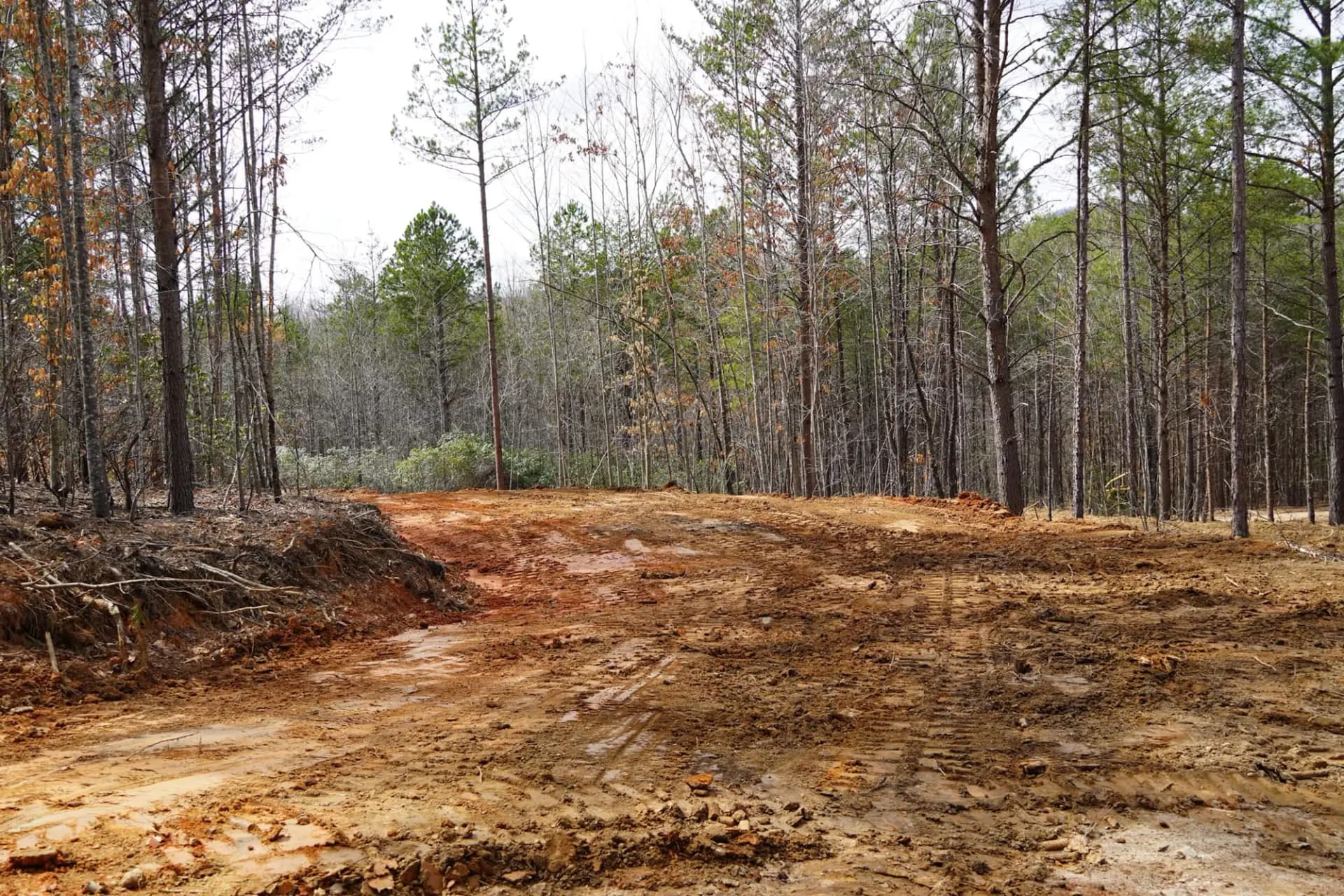
How to get a quote worth trusting
- Have the contractor walk the property with you. A number given over the phone from an address is a guess.
- Be specific about what you want cleared and what you want left. Mature trees you keep are worth money and shade.
- Ask what happens to the debris and whether that is included.
- Ask whether stumps are ground or grubbed, and where.
- Ask what erosion control is included — on sloped ground it is not optional.
- Get it in writing with the scope spelled out, not a one-line total.