
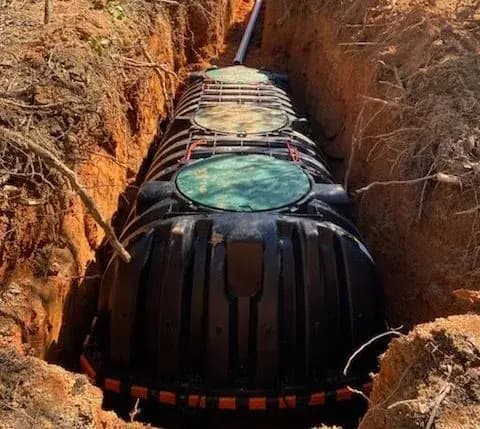
The gap between these two is large — a repair might be $500 to $3,000, while a full system replacement in North Carolina commonly runs $6,000 to $25,000. Which one you are looking at usually comes down to a single question: is the drain field still working?
Warning signs of a failing system
- Slow drains and gurgling throughout the house, not just one fixture.
- Sewage odors indoors, or outdoors over the tank or drain field.
- Soggy ground or unusually lush, green grass over the drain field.
- Backups into the lowest fixtures in the house.
- The tank needing pumping far more often than it used to.
- Standing effluent on the surface anywhere over the system.
One symptom in isolation, especially a single slow drain, is often a plumbing issue rather than a septic issue. Several of these together point at the system.
Usually a repair
| Problem | Typical fix | Typical cost |
|---|---|---|
| Crushed or root-invaded line | Excavate and replace the section | $500 – $2,500 |
| Failed distribution box | Replace and re-level the D-box | $500 – $1,500 |
| Failed effluent pump | Replace pump and floats | $800 – $2,500 |
| Baffle or tee failure | Replace inside the tank | $300 – $1,000 |
| Surface water flooding the field | Regrade, ditch or drain to divert it | $800 – $4,000 |
| Tank never pumped | Pump and inspect | $350 – $700 |
That last category is worth dwelling on. A surprising share of "failing" drain fields in this region are not failing at all — they are drowning in surface water that a grading or drainage problem is routing directly onto them. Fixing where that water goes is dramatically cheaper than replacing a field, and it is the first thing worth ruling out.
Usually a replacement
- The drain field is saturated and no longer accepting effluent. This is the big one, and it is generally not repairable — the soil's ability to absorb has been exhausted or the trenches have clogged with biomat.
- The tank has structurally failed. Cracked, collapsed or corroded tanks, common in older steel and some early concrete tanks.
- The system is badly undersized. Adding bedrooms or a substantial addition can push a system past its permitted capacity.
- The system predates permitting or was never permitted. Older systems may not meet current standards and may need replacing to sell the property.
| System type | Typical installed cost |
|---|---|
| Conventional gravity, 3-bedroom | $6,000 – $12,000 |
| Pump system | $9,000 – $16,000 |
| Low-pressure pipe (LPP) | $12,000 – $20,000 |
| Engineered / alternative system | $15,000 – $30,000+ |
| Tank replacement only | $2,500 – $6,000 |
How the NC permit process works
In North Carolina, septic systems are permitted through your county health department, not the state directly. Two documents matter:
- Improvement Permit (IP): issued after a soil scientist evaluates your site. It establishes what kind of system your soils will support and where it can go.
- Construction Authorization (CA): the actual authorization to install, based on the IP and the specific house it serves.
The soil evaluation is what determines everything downstream. It is why any contractor quoting a septic replacement before the permit exists is quoting a guess — the difference between conventional gravity and an engineered system on the same lot is often more than $15,000.
In our service area, that means Burke County Environmental Health, McDowell County Environmental Health, Rutherford County Environmental Health, Buncombe County Environmental Health, or the equivalent office in your county. Start there, then get quotes.
Making a system last
- Pump the tank every three to five years for a typical household.
- Keep vehicles, equipment and livestock off the drain field — compaction ruins it.
- Do not plant trees near the field; roots find the lines.
- Route gutters, downspouts and surface runoff away from the field.
- Spread laundry loads through the week rather than doing eight on Saturday.
- Nothing but waste and toilet paper down the drain. Wipes are not flushable regardless of the label.