
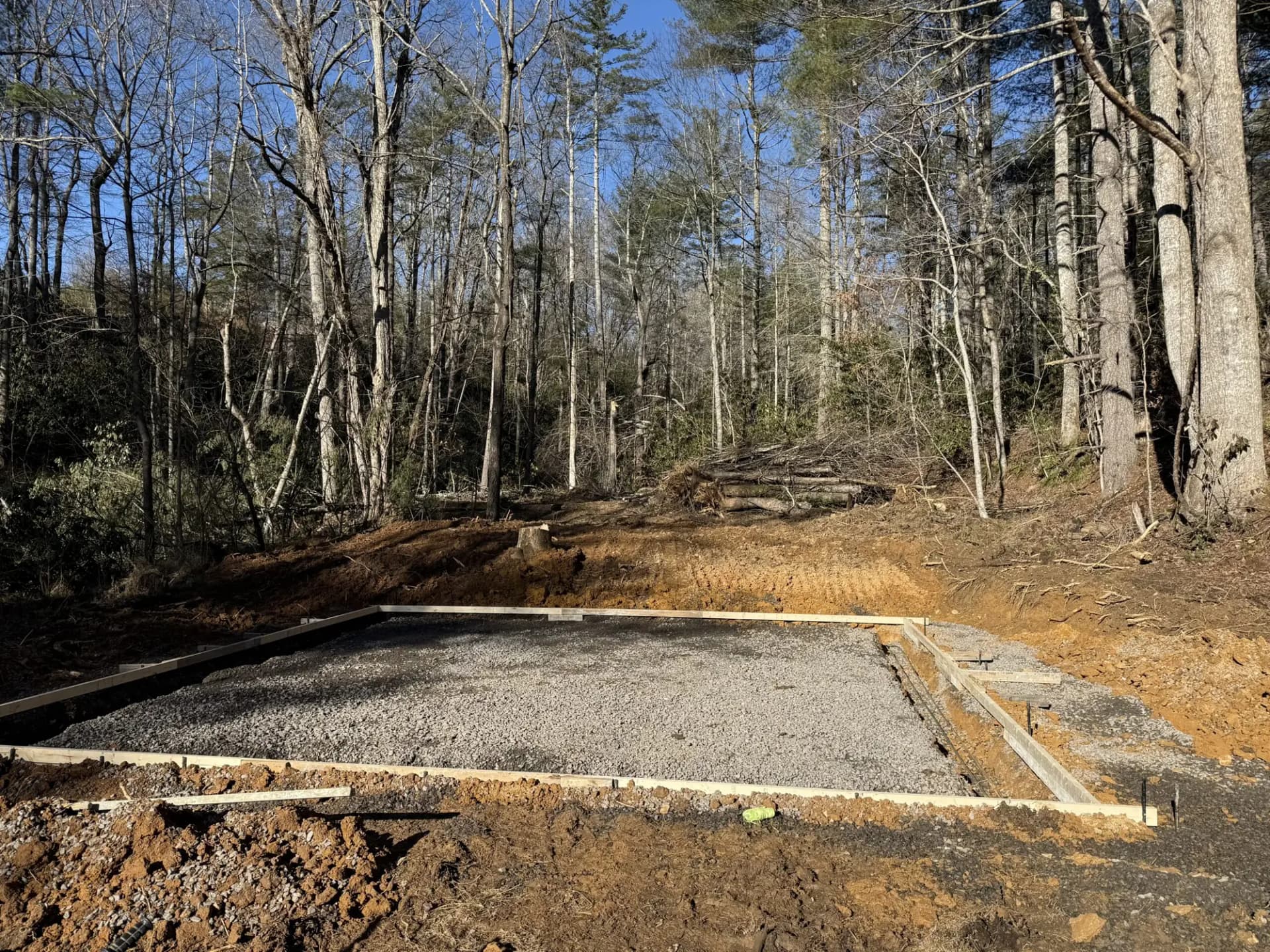
In Western North Carolina, a standard four-inch reinforced concrete slab runs about $7 to $12 per square foot installed. A 24×24 garage slab lands around $4,000 to $7,000. Thicker slabs, difficult access and heavy site prep move that up.
Concrete pricing is unusually easy to compare on paper and unusually easy to get wrong, because the number that varies most between quotes is not the concrete — it is what is underneath it.
Slab cost by project
| Project | Typical size | Typical installed cost |
|---|---|---|
| Shed / small equipment pad | 10×12 | $900 – $1,800 |
| Single garage slab | 16×24 | $2,700 – $4,600 |
| Two-car garage slab | 24×24 | $4,000 – $7,000 |
| Shop floor (6" reinforced) | 30×40 | $10,000 – $18,000 |
| Concrete driveway | 20×40 | $6,400 – $11,200 |
| Patio | 12×16 | $1,500 – $3,000 |
| Sidewalk / walkway | 4 ft wide | $8 – $15 per linear foot |
Thickness: where to spend and where not to
- 4 inches: patios, walkways, sheds and passenger-vehicle driveways. Standard, and adequate for those uses.
- 5 to 6 inches with rebar: anywhere trucks, RVs, trailers, tractors or a vehicle lift will sit or turn. This is the upgrade worth paying for.
- 6 inches or more: commercial approaches, equipment yards and shop floors carrying real loads.
Going from 4 to 5 inches adds roughly 25 percent to the concrete volume, which usually works out to something like a dollar per square foot. On a shop where a loaded truck will park, that is the cheapest insurance in the project.
The part that decides how long it lasts
Most failed slabs in this region did not fail because of the mix. They failed because of what was under them.
Western North Carolina is red clay country. Clay holds water, loses bearing capacity when saturated, and shrinks and swells seasonally. Pour a slab directly on it and you get differential settlement — one part of the slab moves, another does not, and the concrete cracks along the difference.
A proper slab section here is: stripped topsoil, compacted subgrade, four to six inches of compacted crusher run, a vapor barrier where it is going under a conditioned building, then reinforcement supported off the base so it ends up in the middle of the slab rather than lying on the bottom doing nothing.
What else shows up on the bill
- Site prep and grading: clearing, cut and fill, and getting the area level. On a sloped lot this can rival the concrete cost.
- Removal of old concrete: breaking out and hauling a failed slab typically runs $2 to $6 per square foot.
- Access: if the truck cannot reach the pour, a pump adds cost, often $800 to $2,000 depending on reach and time.
- Thickened edges and footings: required where the slab supports a wall.
- Finishes: broom finish is standard; stamped, colored or exposed aggregate add $3 to $10 per square foot.
Curing and when you can use it
| Activity | Wait time |
|---|---|
| Foot traffic | 24 – 48 hours |
| Passenger vehicles | 7 days |
| Heavy trucks & equipment | 28 days |
Cold weather slows curing considerably, and pours below about 40°F need protection to develop strength properly. Late spring through fall is the easy window in this region.